PVC is one of the most widely used plastics worldwide, particularly in PVC pipe manufacturing and industrial piping systems. Due to its excellent mechanical properties, high corrosion resistance, lightweight nature, and relatively low cost, PVC is an ideal material for producing water supply pipes, sewer pipes, gas pipes, and industrial PVC pipes.
However, PVC is sensitive to high temperatures and PVC extrusion processing conditions, and without the use of PVC heat stabilizers, its polymer chains undergo degradation. This thermal degradation leads to discoloration, reduced mechanical strength, and poor processability. Therefore, the use of lead-free PVC stabilizers is essential in PVC pipe production.
Transition Toward Lead-Free Solutions
For many years, lead-based PVC stabilizers were the primary choice in PVC pipe manufacturing due to their high efficiency and low cost. These stabilizers provided excellent thermal resistance and enabled the production of high-quality pipes. However, environmental and health concerns associated with lead resulted in strict regulations and eventual bans in Europe, the United States, and many other regions.
As a result, manufacturers were compelled to seek alternatives to lead stabilizers, focusing on eco-friendly, non-toxic PVC stabilizers that can maintain thermal stability, color retention, and mechanical performance.
Thermal Performance and Color Stability (Calcium-Zinc Stabilizers: Lead-Free PVC Pipes)
Lead-free PVC stabilizers, such as calcium-zinc stabilizer systems (Ca-Zn stabilizers) and advanced organic compounds, have emerged as effective replacements for traditional lead stabilizers. These systems prevent the release of chlorine from PVC polymer chains, which is the primary cause of thermal degradation.
One advanced technology in this field is the use of blocked mercaptan stabilizers for PVC. These compounds activate only at processing temperatures, providing effective protection without common mercaptan issues such as odor or incompatibility with other additives. As a result, PVC color stability is maintained throughout processing and service life.
One of the key advantages of calcium-zinc stabilizers for PVC pipes is enhanced color stability. In white PVC pipes, uniform color and resistance to yellowing are especially critical. Modern stabilizer systems activate during the early stages of extrusion, preventing discoloration and ensuring a smooth, uniform pipe surface.
In addition, these systems positively influence PVC melt flow behavior and viscosity control during extrusion, allowing precise control of pipe diameter and wall thickness. This improves final product quality, reduces material waste, and increases efficiency in PVC pipe extrusion lines.
Advantages of Modern Stabilizer Systems
Beyond improving thermal and color stability, lead-free stabilizers for PVC also enhance PVC processability. Extrusion lines can operate at higher speeds with improved stability, reducing the risk of processing defects.
These stabilizers exhibit excellent compatibility with other additives such as PVC lubricants, fillers, and pigments, and they often achieve equal or superior performance at lower dosages compared to traditional systems. This leads to reduced PVC pipe production costs and improved economic efficiency.
Impact on Recycling and Environmental Sustainability
Lead-free calcium-zinc stabilizers play a critical role in PVC recycling. Recycled PVC materials typically suffer from reduced thermal stability and color degradation due to prior processing. Modern stabilizer systems help maintain PVC performance and appearance even after multiple recycling cycles.
This allows manufacturers to incorporate higher percentages of recycled PVC in pipe production without compromising quality. Consequently, production costs are lowered, natural resource consumption is reduced, and environmental sustainability is enhanced.
Comparison of Calcium-Zinc and Lead-Stabilized PVC Pipes
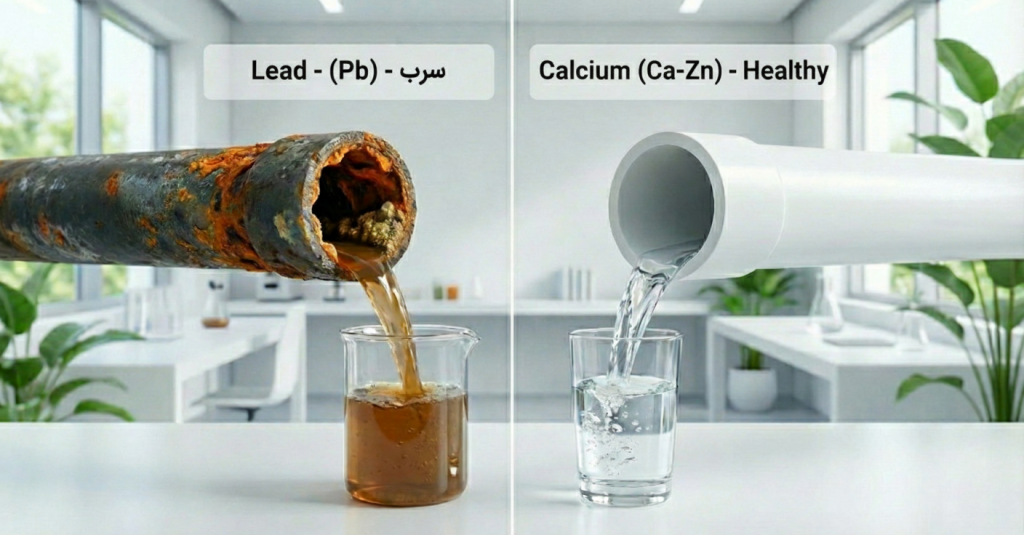
Traditional PVC pipes containing lead-based stabilizers offer good thermal resistance and low cost but pose serious environmental and health risks and limit recyclability.
In contrast, PVC pipes stabilized with calcium-zinc systems are completely safe and suitable for drinking water pipes, sewage systems, and industrial applications. These pipes feature uniform color, smooth surfaces, and retain their mechanical properties even after repeated recycling. High processing stability also enables manufacturers to run extrusion lines at higher speeds with greater confidence.
International Standards and Customer Trust
The use of lead-free PVC stabilizers allows manufacturers to comply with international PVC pipe standards (ISO, EN, ASTM) and access global export markets. Pipes produced with non-toxic materials inspire greater consumer confidence and position manufacturers as environmentally responsible and sustainable brands. In markets with strong health and environmental awareness, this represents a significant competitive advantage.
The Future of PVC Pipe Manufacturing (Calcium-Zinc Stabilizers: Lead-Free PVC Pipes)
Modern lead-free stabilizers represent a new generation of PVC additives designed to meet evolving environmental regulations and industrial demands. These systems offer easy processing, high thermal stability, consistent color, and improved recyclability.
By adopting calcium-zinc stabilizers for PVC, manufacturers can produce pipes with longer service life, higher quality, and stable long-term performance while remaining fully compliant with global standards. These advanced stabilizers are shaping the future of lead-free PVC pipe manufacturing, driving the industry toward safer, more sustainable, and more advanced solutions.
Read more: