(Phthalate-Free Plasticizers – Non-Phthalate Plasticizers)
Plastics are widely used materials, including synthetic and semi-synthetic compounds. Plastic additives (Plastic Additives), especially plasticizers (Plasticizers), play a key role in the plastic manufacturing process, enhancing flexibility, durability, and longevity. Since the COVID-19 pandemic, the use of disposable face masks (Disposable Face Masks) has significantly increased among the general public. As plasticizers are added to synthetic polymers during production, they can potentially lead to human chemical exposure (Chemical Exposure to Humans).
The most commonly used plasticizers are phthalates (Phthalates), also known as phthalic acid esters (PAEs). In recent years, these compounds have faced strict restrictions due to their high toxicity for all living organisms, including humans. These regulatory limitations have increased the use of phthalate-free plasticizers (Non-Phthalate Plasticizers – NPPs) in industrial applications.
Manufacturers widely use phthalate-free plasticizers in consumer products, and researchers regularly detect them in human and environmental samples. However, scientists still have limited information about their environmental effects, ultimate fate, and the risks that human exposure may pose, especially for newer compounds. Therefore, this study examines industrial limitations, types, environmental prevalence, sources, and impacts of phthalate-free plasticizers on living organisms and human health.
Expansion of Plastic Consumption and Role of Plasticizers
Today, plastics are an integral part of daily human life, ranging from food packaging (Food Packaging) and healthcare products to medical devices (Medical Devices) and consumer goods. This widespread use has led to significant plastic entry into the environment, contributing to plastic pollution (Plastic Pollution). In 2021, global plastic production reached approximately 390 million tons, and it is projected to increase to around 1,480 million tons by 2050.
To achieve properties such as flexibility, durability, and performance, plasticizers are used in the production process (PVC Plasticizers, Plastic Additives). These chemical compounds are widely applied in PVC, food packaging, children’s toys, adhesives, and medical equipment. Currently, tens of thousands of chemical compounds can be used as plasticizers, accounting for roughly one-third of the global plastic additives market (Global Plastic Additives Market).
Plasticizers attract research attention due to their environmental impacts and potential health risks. Many of these compounds are endocrine-disrupting chemicals (Endocrine Disrupting Chemicals – EDCs), which can interfere with normal growth and reproductive function. Among them, phthalates are the most commonly used but have faced strict legal restrictions due to high toxicity.
Presence of Phthalate-Free Plasticizers in the Environment and Emerging Challenges
Phthalate-free plasticizers are currently used in a wide range of polymeric products. Compounds such as dibutyl sebacate (Dibutyl Sebacate), tributyl phosphate (Tributyl Phosphate), and various adipates (Adipates) are applied in synthetic polymers and play a critical role in soft plastics, especially packaging and food films (Food Plastic Films).
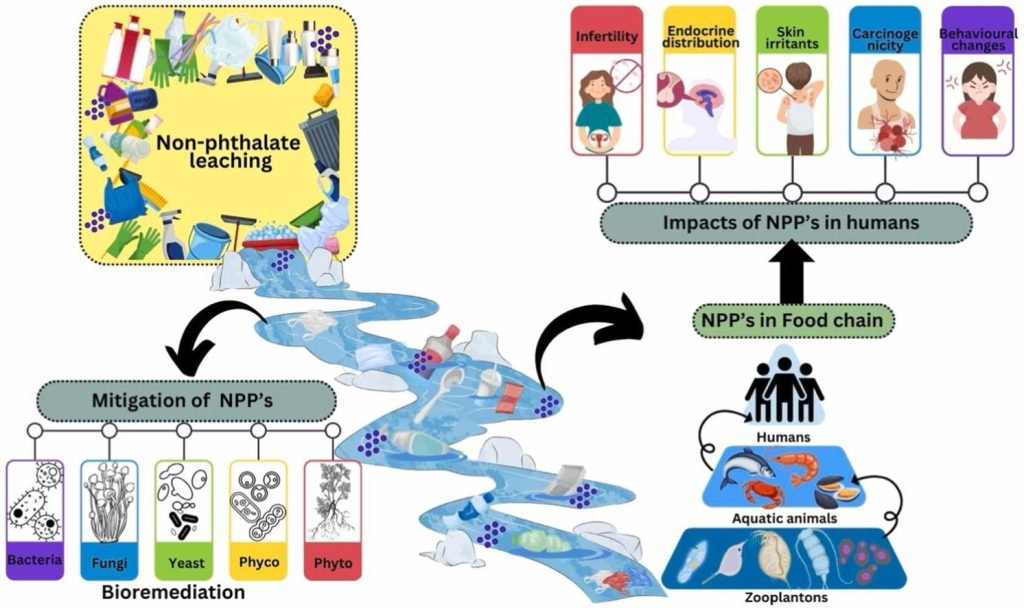
Research has shown that these compounds do not remain confined to plastic products but are also detected in food-contact materials, medical devices, rivers, air, household dust, food items, and even aquatic organism tissues (Aquatic Ecosystems). The rapid growth of the global phthalate-free plasticizers market (Non-Phthalate Plasticizers Market) further emphasizes the importance of this issue.
Plasticizer Migration and Biological Effects
Since plasticizers are not chemically bound to the polymer matrix, they can gradually migrate from plastics into the surrounding environment – a process known as chemical migration (Chemical Migration). This migration can occur through contact with food, medical devices, or improper waste disposal.
Although the toxicity of phthalate-free plasticizers is not fully studied, some exhibit behavior similar to endocrine-disrupting chemicals. These compounds can disturb the hormonal balance of living organisms, reduce beneficial soil microorganisms (Soil Microorganisms), and weaken ecosystems.
Pollution Control, Challenges, and Future Outlook
Industrial expansion and urbanization, coupled with increased plastic consumption, continuously introduce persistent chemicals into the environment. Phthalate-free plasticizers, due to their high environmental persistence (Environmental Persistence), can remain in soil and water for extended periods. While past research focused mainly on phthalates, data on the long-term environmental fate and impacts of phthalate-free plasticizers remain limited.
Reducing production, improving plastic waste management (Plastic Waste Management), raising public awareness, and developing innovative pollution-reduction technologies are critical strategies to address these emerging contaminants (Emerging Contaminants).
Purchase of Non-Phthalate Plasticizers – Pak Chemical Company, Pishrochem Brand
Pak Chemical Company is proud to offer its non-phthalate plasticizers with the highest quality and international standards. This product, with the following features, is an ideal choice for use in the food, medical, and consumer industries:
- Non-phthalate and free of harmful compounds for human health
- Enhances flexibility and durability of plastic products
- Environmentally friendly and reduces pollution risk
- Suitable for all types of soft polymers and sensitive packaging
For pricing and product details, please contact our sales team and benefit from our professional consultation.
Read more: