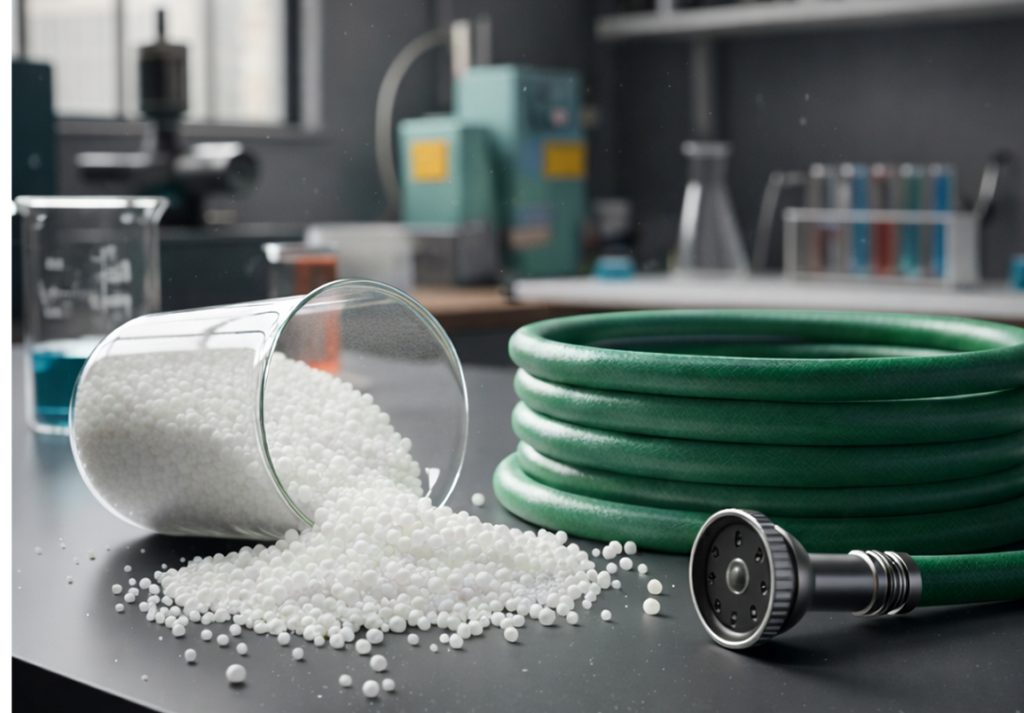
PVC granule refers to the granular and ready-to-process form of polyvinyl chloride polymer produced by petrochemical industries. These granules are uniform, portable, and suitable for direct use in production lines, making work with raw materials much simpler and more precise for manufacturers. To convert PVC granules into a final product, it is sufficient to melt them under heat and then shape them into the desired form using molds or forming equipment.
In the production process, manufacturers heat PVC resin inside an extruder until it reaches a molten, paste-like state. After the material exits the die head, a cutting unit quickly cuts it into small granules. The process then cools and packages the granules for distribution and use in various industries.
Granule purity is very important during storage. Companies must prevent PVC granules from mixing with other materials and protect them from environmental contamination, because impurities can reduce the quality of the final product. Manufacturers use PVC granules in pipes and fittings, wires and cables, door and window profiles, flooring, injection-molded parts, and many other plastic products. Good processability, high durability, and cost-effectiveness make PVC granules one of the most widely used materials in the polymer industry.
What Variables Affect PVC Granule Production?
In the PVC granule production process, the goal is not merely converting raw material into granular form; rather, it is achieving a compound with engineered properties and defined performance. By considering a set of processing parameters, the manufacturer aims to produce a uniform, stable granule tailored to the final application. Manufacturers precisely control variables such as process temperature, pressure, catalyst type, and raw material quality to ensure correct polymer structure formation and achieve the desired characteristics.
During the melting and forming stage, heat softens PVC resin into a paste-like state. The process then shapes and cuts the material into granules. Proper adjustment of operating conditions at this stage plays a decisive role in properties such as strength, processability, surface uniformity, and thermal stability of the granule. Even the smallest fluctuation in these parameters can affect the quality of the final product.
Another important point is melting and recycling cycles. Manufacturers produce and process these polymers for the first time, and the industry recognizes them as virgin raw materials with the highest levels of physical and mechanical properties. With each repeated melting and reshaping, part of these properties decreases; an issue that receives special attention in formulation design and granule selection for sensitive applications.
Various Applications of PVC Granule
PVC granule, as one of the most widely used base materials in the plastics industry, has a very broad range of applications in today’s world. This material enables the production of products that would not be economically justifiable if made from many alternative materials. At the same time, products made from PVC do not only offer price advantages, but also rank high in terms of quality, durability, and performance. PVC granule manufacturers, aware of these capabilities, supply compounds designed and optimized according to the needs of each industry.
Application of PVC Granule in the Construction Industry
One of the most important areas of PVC granule consumption is the construction industry, where the combination of strength, low weight, and environmental resistance is highly important. Among its prominent applications is the production of building sewage pipes. Construction projects widely use PVC pipes (Polika). They are lightweight and easy to install, and they resist moisture penetration, corrosion, and harsh environmental conditions. In addition, these pipes provide a long service life.
Production of PVC Ceilings
PVC granule plays an important role in the construction industry in producing lightweight yet durable ceilings. The use of this material has significantly reduced project implementation costs without reducing structural strength or durability. PVC ceilings resist moisture penetration and water leakage and perform reliably under various climatic conditions. Moreover, the cost-effectiveness of these products compared to many traditional options has made them a practical and economical choice in construction projects.
Application in the Production of Consumer Goods and Equipment
Manufacturers also use PVC granules to produce a wide range of consumer goods and equipment. Flexibility in formulation, precise shaping capability, and suitable durability make this material an ideal option for manufacturing parts and bodies of various household and industrial equipment. By using engineered granules, manufacturers can offer products with appropriate surface quality, desirable strength, and long service life — features that are clearly noticeable to the end consumer.
Electronic Equipment and Mobile Phone Covers
Today, mobile phones have become one of the most widely used everyday devices, and few people realize that manufacturers make a significant portion of the protective covers and bodies of some of these devices from PVC. The use of PVC granule in this field enables the production of resistant, flexible, and lightweight parts. These characteristics allow electronic equipment to have greater durability against impact, abrasion, and environmental factors. In addition, manufacturers use PVC granules to produce a wide range of household, industrial, and agricultural equipment, and its high strength and economic efficiency make it a suitable replacement for many other materials.
Credit Cards and Identification Cards
Manufacturers also make the body of most credit, banking, and identification cards from PVC. High physical stability and resistance to abrasion, breakage, and environmental factors have made PVC granule an ideal material for producing these products. These cards maintain their shape and surface quality over time while providing sufficient safety and durability for daily use.
Application in the Apparel Industry and Artificial Leather
In the apparel industry, a leather-like material known as “Rexine” is widely recognized, and its main base is PVC. Manufacturers produce this material by modifying and engineering the structure of PVC granules to achieve an appearance similar to natural leather while maintaining suitable flexibility and durability. For this reason, it has found wide application in the production of shoes, clothing, bags, household furniture, and decorative coverings.
Production of a Wide Range of Consumer and Industrial Products
The scope of PVC granule usage extends far beyond the cases mentioned.Manufacturers use it to produce medical equipment such as medical tubes and blood bags, flooring, food packaging, disposable tableware, hoses, traffic cones, vinyl fences, and many other products. The combination of durability, formability, and cost-effectiveness has turned PVC granule into one of the fundamental and strategic materials in various industries — a material whose presence in everyday life is greater than it may appear at first glance.
Polyvinyl Chloride (PVC)
Polyvinyl chloride (PVC) granules are one of the most widely used polymer raw materials and are supplied in various grades and colors, including black, natural, colored, and transparent. Due to its high durability, suitable lifespan, and good processability, this material has wide application in the production of rigid and flexible products and meets the needs of various industries.
PVC granule, as an engineered material, enables application in various fields including building and construction, medical equipment, and packaging. Physical stability, appropriate mechanical strength, and desirable electrical properties have made this material a reliable option in sensitive industrial applications.
Among the most important uses of PVC granule are cable insulation, flame-resistant sheathing, various hoses and conduit pipes, disposable medical tubes and tubing, protective coatings and sheets, shoe soles, bags, and flexible polymer products. These granules are available in different sizes, colors, and grades suitable for production processes such as extrusion and injection molding.
Product Range:
• PVC Black
• PVC Natural
• PVC Colour
The PVC granules offered in this product range, with color and grade diversity, meet the needs of a wide spectrum of industrial applications.Suitable stability, structural uniformity, and long storage life make these materials useful in various processes such as injection molding, extrusion, and the production of different PVC products. They also have significant application in the production of PVC waterstops, channel seals, sealing components, and other engineering compounds.
Polyvinyl chloride granule, while lightweight, has desirable mechanical strength, which makes it an efficient option for producing products such as disposable medical tubes, cable insulation and sheathing, flame-resistant coverings, conduit pipes, garden hoses, bags, shoe soles, and other flexible components. Stable physical properties, long-term durability, and suitable electrical characteristics ensure reliable performance of these products under various working conditions.
Manufacturers supply these granules in various sizes, colors, and technical specifications tailored to different production processes, allowing greater flexibility in designing and optimizing formulations and final products.
Outstanding Features of PVC Granules
• Uniform size and diverse colors
• Long shelf life
• Environmentally friendly
• Suitable flame-retardant and strength properties
• Good physical and electrical properties
• Transparent PVC color
• Ideal density
• High thermal stability
• Chemical resistance
• Excellent elasticity
• No unpleasant odor
• Non-toxic, non-polluting, and recyclable
• Optimal strength
• Improved shape and dimensions
• Easy processability
• Competitive price
• Temperature resistance and moldability into various shapes
• Recycled and rigid PVC granules available in different specifications
• Suitable for producing final products with high colorability
• Attractive colors, lightweight, and uniform sizes
• Long service life and guaranteed durability of final products
• Good flame-retardant, physical, and electrical properties with high strength
Advantages of PVC Compared to Other Materials
PVC has replaced traditional building materials such as wood, metal, concrete, and clay in many applications.
Diversity of applications, cost-effectiveness, and an excellent track record of use have made it the most important polymer in the construction sector; so that in 2006 this sector accounted for about 60 percent of PVC production in Europe.
Polyvinyl chloride (PVC) is one of the most popular plastics in building and construction. This material is used in various products such as PVC waterstops, PVC NCL and NCT seals, reinforced PVC pipes, PVC tubing, drinking water and sewage pipes, window frames, flooring and roof coverings, wall cladding, cables, and many other applications, because it offers a modern alternative to traditional materials such as wood, metal, rubber, and glass. These products are often lighter, less expensive, and provide greater performance advantages.
Read more: